October 8, 2026

AEDC at 75: Gemini jumps so Apollo can fly
BRAD HICKS AEDC Contributor
Thousands of testing hours were dedicated to the Project Apollo space program throughout the 1960s at what was then known as Arnold Engineering Development Center, but Center efforts also focused greatly on the precursor to Apollo in the early part of the decade.
Project Mercury, which was launched in 1958 and was the first U.S. manned spaceflight program, preceded Gemini. Through Mercury, Alan Shepard became the first American in space on May 5, 1961. Just shy of three weeks later, then-President John F. Kennedy challenged the U.S. to put an American on the moon and return them safely before 1970.
Apollo would accomplish Kennedy’s objective in 1969 but, before attempting touchdown on the lunar surface, NASA needed a “trial run.” Project Gemini served this purpose and effectively bridged the Mercury and Apollo programs.
Project Gemini was announced on Jan. 3, 1962. A two-man spacecraft that would be used for Gemini missions was under development at the time. The objectives of Gemini were to subject astronauts to long-duration flights, to develop effective methods of rendezvous and docking with other orbiting vehicles and the maneuvering of docked vehicles in space, to perfect methods of reentry and landing at a preselected point, and to obtain greater insight on the impact of weightlessness on the crew during the longer flights.
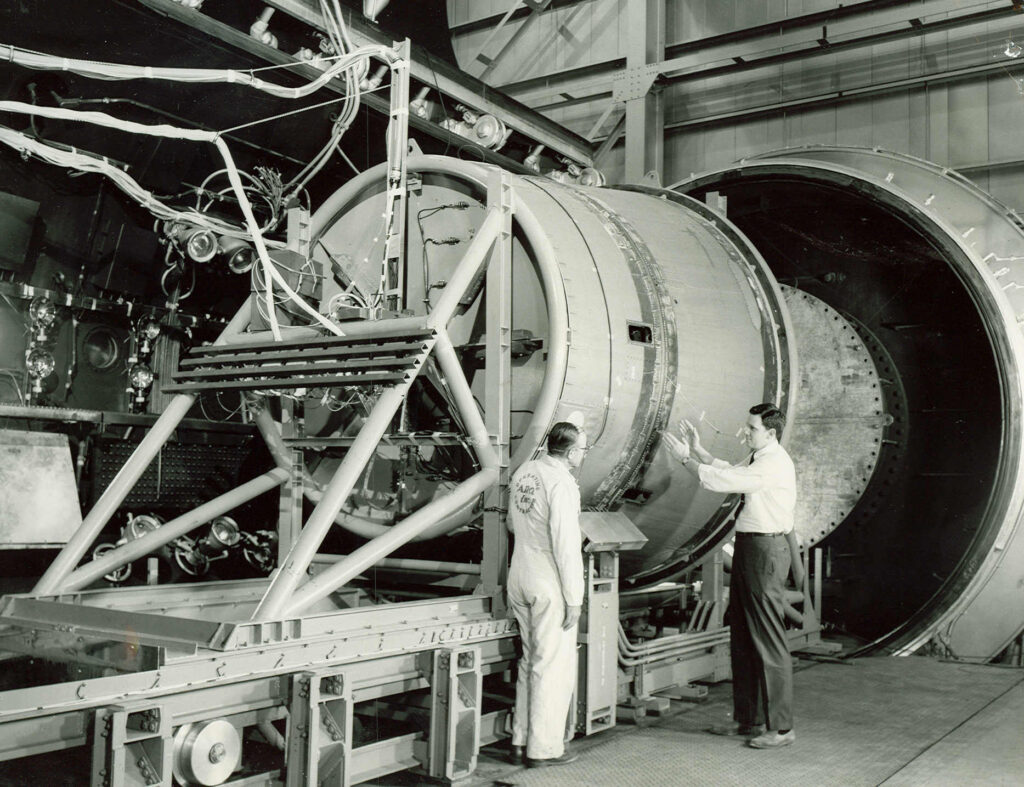
A little more than 5,800 “occupancy hours” are listed as Gemini support on the master log of test work conducted across AEDC test facilities. Work to support the program included aerodynamic and propulsion tests.
Although those involved were unaware at the time, work at AEDC, today known as Arnold Engineering Development Complex, that would eventually support the Gemini program can be traced back to the late 1950s when an early version of the Agena engine was installed in an AEDC test cell.
The Agena target vehicle was an uncrewed spacecraft used during Project Gemini to develop space rendezvous and docking techniques in preparation for the subsequent Apollo missions.
“Even the center’s early work on the Atlas, used to launch the Gemini-Agena target vehicle, can be considered part of the center’s contribution to the Gemini program,” states Beyond the Speed of Sound, a book detailing the history of AEDC.
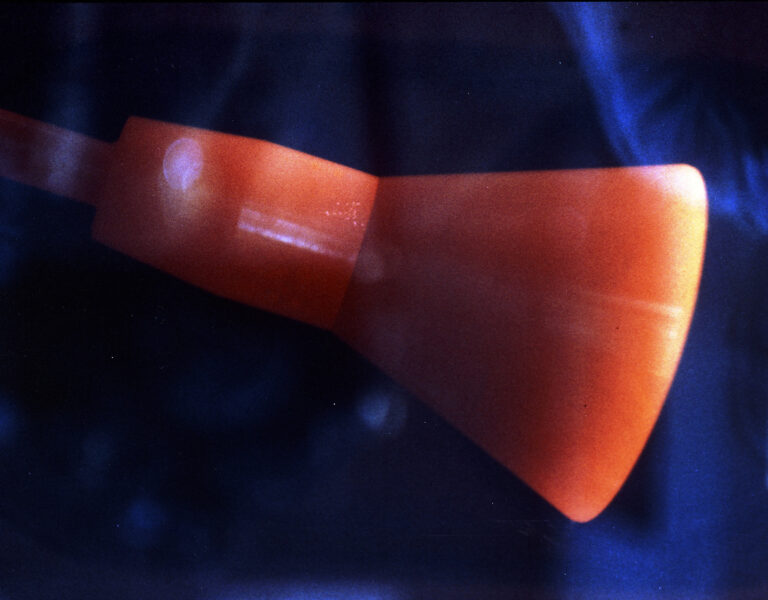
Before the first Gemini capsule was built, models of the proposed capsule were subjected to extreme reentry conditions in high-speed AEDC wind tunnels. These tests helped direct the design and structure of the capsule and the ablative shield used to protect those inside upon entering Earth’s atmosphere.
A full-scale, dynamic stage separation test was conducted for the first time in 1963 by simulating a Gemini mid-altitude abort using the retrorockets for stage separation and capsule escape during the boost phase of launch. During an abort, the manned capsule would essentially be pulled away from the booster.
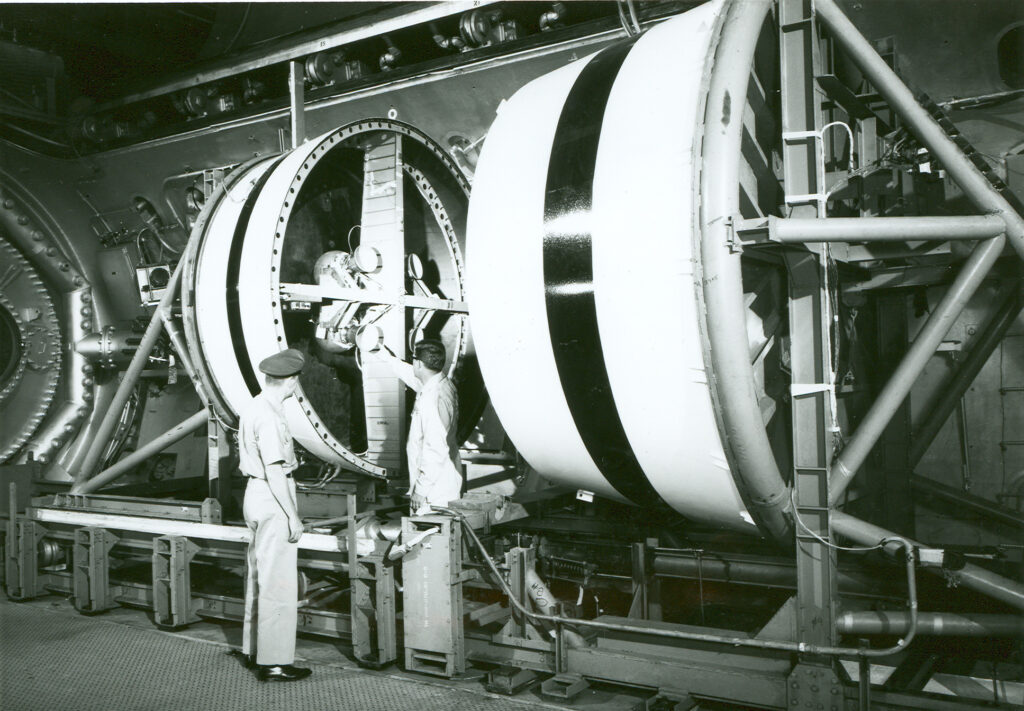
“The test simulated spacecraft retro abort at an altitude of 70,000 feet by firing a full-scale spacecraft afterbody (consisting of a heat shield and retrograde rocket system on a rail-borne carriage),” states Beyond the Speed of Sound. “The retrograde section of the Gemini adaptor section was separated from the equipment section by a linear-shaped charge and the retromotors accelerated the capsule system down the track. Spacecraft drag was simulated with a constant-force cylinder mechanism.”
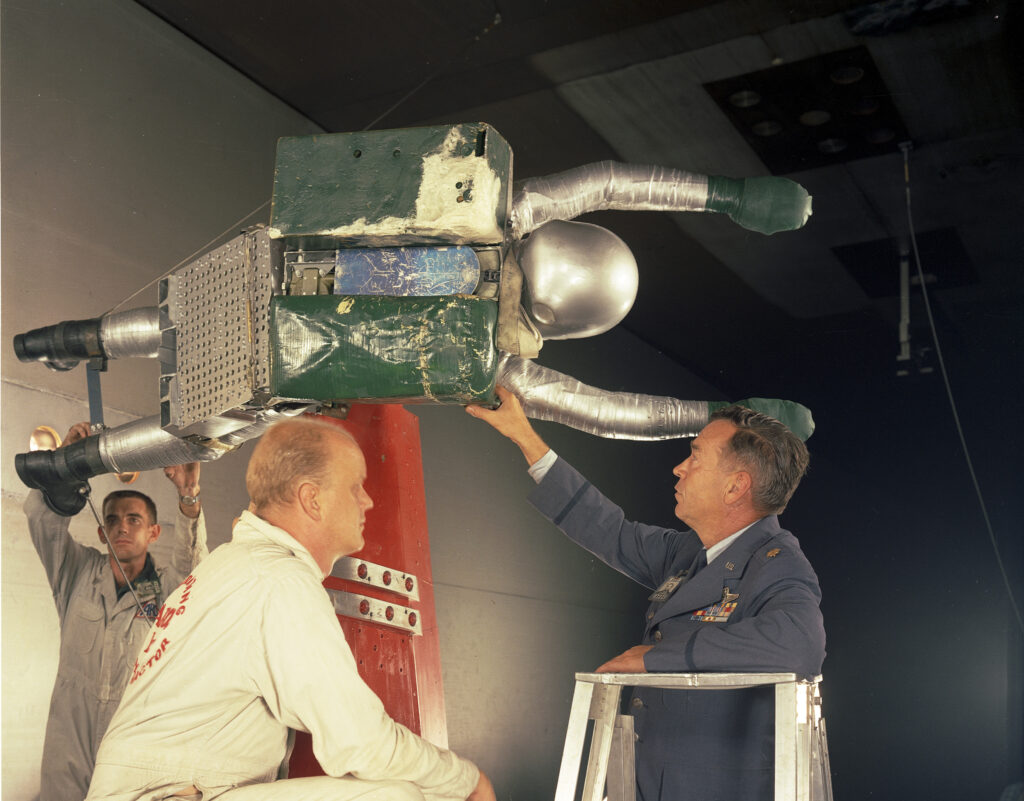
The Gemini escape system was subjected to additional testing at AEDC. One such effort was conducted to determine the deployment, inflation and drag characteristics of a close-coupled ballute decelerator attached to a full-scale manikin.
“The ballute system was intended to stabilize and decelerate the astronaut prior to parachute deployment in the Gemini emergency escape system,” Beyond the Speed of Sound states. “Deployments of the initial ballute configuration were unsuccessful. Various modifications were accomplished until two successful deployments were achieved. Drag levels for the configurations tested were now lower than required and no further modifications were necessary as determined by the contractor.”
Testing of the Agena engine became a heavy focus at AEDC following failure of the target docking vehicle during the October 1965 Gemini 6 mission. An uncrewed Atlas-Agena target vehicle was launched but, after the Agena engine fired to separate it from the Atlas, the vehicle exploded. The mission was aborted.
A program initiated by the Air Force and NASA known as “Sure Fire” was given top priority in the wake of this event.
“Under a project called ‘Sure Fire,’ engineers and support personnel at the center worked around the clock to pinpoint the cause of that failure and to prove the reliability of ‘fixes’ that had been made in the engine’s fuel and electrical systems,” Beyond the Speed of Sound states.
The first test under the program occurred at AEDC on Feb. 7, 1966, and five additional tests were successfully conducted over two days. Analysis from the final firing indicated a need to make some minor adjustments to the engine, modified after Gemini 6, including replacement of the gas generator fuel valve and a change in the instrumentation lines.
A checkout firing was started at a high altitude on Feb. 12, 1966.
“Countdown was initiated, and all systems functioned normally until the point of ignition, at which time the engine failed,” Beyond the Speed of Sound states. “A ‘hard start’ caused the injector head to separate from the thrust chamber around the circumferential weld that joins the two.”
With setbacks in the rearview, the first of more than 20 successful tests with the second Agena engine began on March 1, 1966.
The Agena engine that would put a target vehicle into orbit for rendezvous with Gemini 8 on March 16, 1966, passed the last of its ignition reliability and mission simulation tests at AEDC. In a final test run that lasted three minutes at simulated high altitudes, the engine performed perfectly.
Following the one dozen Gemini flight missions that occurred from spring 1964 to fall 1966, then-AEDC Commander Brig. Gen. Lee Gossick commented on the Center’s support of the program.
“The United States can be proud of its achievement in the Gemini program,” Gossick said. “There were minor difficulties, but the final tabulation stands at 12-for-12 – a perfect record that I’m sure was made possible to a large extent by the splendid test support provided by the Arnold Center.”
This is the 25th in a series of articles highlighting the history of Arnold Engineering Development Complex during its first 75 years. Additional articles will be published throughout 2026 to commemorate the anniversary of AEDC. All photos courtesy of the U.S. Air Force.