The man behind Voyager marks 92nd trip around Sun

Dr. Gary Flandro. You may not recognize his name, but you know his work. Voyager 1. Voyager 2. One of the most ambitious and longest lasting endeavors in the history of space exploration was made possible by his work. As a graduate student from California Institute of Technology (Caltech) in 1964, he was working parttime at NASA’s Jet Propulsion Laboratory (JPL) when he was assigned to envision possible space missions past Mars.
Flandro’s life’s work with space exploration began at age 6, when he was gifted the book, Wonders of the Heavens. It showed pictures of what scientists imagined the planets to look like, and drawings of the solar system with the planets all aligned. Even at 6 years old, he thought, “How neat it would be to go all the way through the solar system and pass each one of those outer planets.” A drawing of a rocket ship going through space fired his imagination, as he was already an enthusiastic devotee of Buck Rogers and Flash Gordon comics.
Years later, once assigned to work on much that same idea, Flandro sat down with paper and pencil and plotted out future positions of Jupiter, Saturn, Uranus, and Neptune. He found that those planets would be in alignment from 1976 to 1978, and that 1977 would be an ideal launch date for a spacecraft to make the “Grand Tour.” Using the already known “gravity-assist” or “slingshot” method (remember playing crack-the-whip in school?) of using a planet’s own gravity field to propel a spacecraft, Flandro calculated that a craft could make the journey to all four planets within ten to twelve years. Much of the trajectory calculating he did by hand. Without using that alignment and “gravity- assist,” that same mission would take decades. Flandro knew another critical factor; the next such alignment would not take place for another 175 years.
It was an ambitious idea. No probe had ever lasted anywhere close to a decade in space. Many of his superiors did not believe this young graduate student’s idea would work. Flandro recalls being told, “You just cannot do that.” “Stop wasting your time.” “Come on, kid, don’t bother us anyone.” But he persisted, and, slowly, brought the others around with sound math.
Finally convinced, NASA went to Congress for funding. Congress rejected the mission, but countered with a cheaper version that would venture out no further than Saturn. NASA took the offer with a wink and a smile. Congress would never know the difference. They went straight to work building two spacecraft capable of going all the way to Neptune. All flaws were corrected. Sun sensors were boosted. Fuel saving techniques were used that would keep the mission viable long past the expected expiration. In the end, Congress wound up funded the extended mission NASA had been developing all along.
Voyager 2 was launched August 20, 1977, and Voyager 1 launched a few days later, on September 5, 1977. Voyager 2 had a longer trajectory than Voyager 1, and was thus launched first. Both have sent back reams of data on both the planets and their moons, and revealed some surprises. Volcanic activity on one of Jupiter’s moons. Vast seas under the frozen surface of Neptune. Brilliant pictures.
Voyager 1 left our solar system on August 25, 2012, and Voyager 2 left November 5, 2018. They now travel deep space, emissaries of earth. Each has a golden disc attached with a wealth of information about earth and its inhabitants. There is a message from then President Jimmy Carter, greetings in 55 languages, music, earth sounds, pictures, and scientifi c data to include the structure of DNA. Carl Sagan headed the committee that selected the information included on the discs.
Getting back now to our subject, Dr. Gary Flandro. His storied career is filled with awards and accolades. He was a professor at University of Utah, and later came to UTSI, where he taught and held the Boling Chair of Excellence in Mechanical and Aeronautical Engineering from 1991 until his retirement in 2009. After that he became Vice President and Chief Engineer, and part owner, at Gloyer-Taylor Laboratories (GTL) in Tullahoma. He received the NASA Exceptional Achievement Medal in 1998.
While with GTL, Dr Flandro worked with Paul Gloyer in solving yet another problem that had been plaguing NASA for years, that of rocket combustion instability. (Gloyer had been a former student of Flandro while both were at UTSI.) As rocket fuel combusted to provide needed thrust, it could cause vibrations at rates that could be harmful, even fatal, to crews on manned flights. Long (and extensively detailed) story short, Flandro and Gloyer developed a way to predict and correct the problem that NASA had spent billions to solve, even scrapping missions along the way. So, Dr. Flandro’s career was bookended with two of the most significant achievements in the history of space flight and exploration.
Dr. Flandro and his wife, Ora Lee, moved to Tullahoma in 1991 when he started at UTSI. She has been a constant support for him, even working at JPL as a secretary while he was there. They raised three sons here. Yes, this giant in the space industry has lived here in Tullahoma quietly for decades.
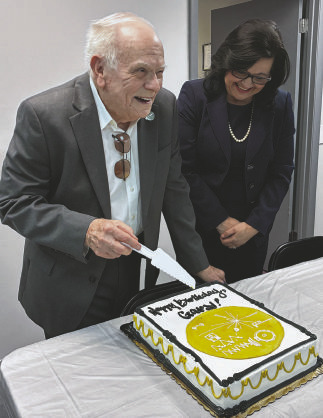
Flandro’s birthday party, celebrating his 92nd year, was hosted by Bill Boss and Austin Sisco with the Hands-On Science Center, and was attended by executives of the center, as well as those of Gloyer- Taylor Laboratories. Boss presented Dr. Flandro with a House Joint Resolution from the Tennessee House of Representatives recognizing him for his contributions to the Voyager program. Janet Ivey, a science educator who hosted the television show, Janet’s Planets, attended and brought Chennel 2 News with her. The birthday cake was adorned with a replica of the Golden Disc.
Finally, asked what advice he would give young people interested in space, Flandro replied, “Be curious. Curiouser and curiouser is the way to go.”