Services today for ‘Greatest Ranger That Ever Was’

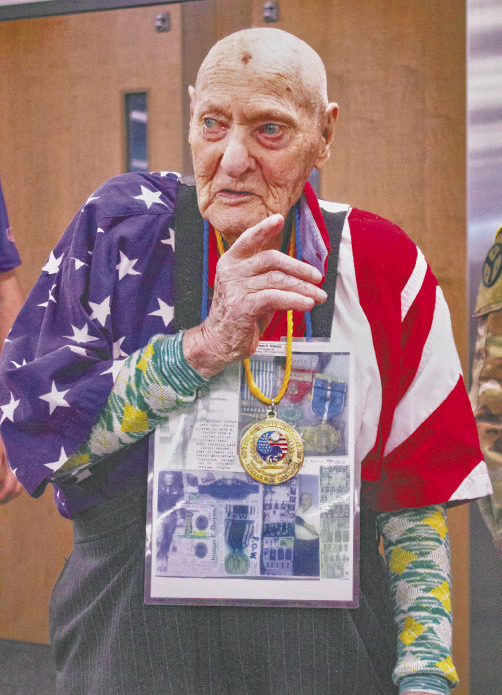
Thomas Edward Gwynn, one of Tullaboma’s oldest residents, and “The greatest Ranger that ever was” passed this life on Monday, April 6, 2026 at Life Care Center at the age of 106, just two months shy of his 107th birthday.

Mr. Gwynn was born June, 2, 1919 in Moscow, Tennessee. He joined the United States Army in 1940 and became an Army Ranger in April of 1943. Mr. Gwynn served in World War II and fought in numerous historic battles, including D-Day, Battle of the Bulge, Battle of Normandy, and witnessed Victory in Europe Day on May 8, 1954, which marked the end of World War II. Five years later, he returned to battle, fighting in the Korean War, where he fought in the Battle of Inchon. Mr. Gwynn was a prisoner of war twice, and escaped captivity both times. Because of his bravery, he earned numerous awards, including 12 Purple Hearts, the Silver Star, the Presidential Unit Citation, the Bronze Star, the Combat Badge, the Prisoner of War Medal and the Distinguished Service Cross.

Visitation will be held on Wednesday, April 15, 2026 at Kilgore Funeral Home from 11 a.m.-1 p.m. with the funeral to immediately follow at 1 p.m. Burial with military honors will follow at Bethany Cemetery in Normandy.

To say Gwynn has lived a life worthy of a Hollywood movie is an understatement as the military veteran fought in two wars, was captured and escaped two times from behind enemy lines and was wounded 24 times.

“When bullets are flying, there is no pain,” Gwynn said of the battlefield, giving the praise to God for bringing him home from war where he was conferred the Purple Heart 12 separate times.

Amongst Gwynn’s history of heroism was his participation in DDay, June 6, 1944 – something he has long celebrated as his second birthday, noting it is “because I survived D-Day.”

Gwynn joined the military armed forces in 1940 and became an Army Ranger in April of 1943. In 1943, Gwynn’s unit was sent to England. He has taken part in some of the most significant battles, including the Normandy invasion. The Battle of Normandy resulted in the Allied liberation of Western Europe from Nazi Germany’s control. Codenamed Operation Overlord, the fight began on June 6, 1944. On that day, about 156,000 American, British and Canadian forces landed on five beaches along a 50-mile stretch of the greatly fortified coast of France’s Normandy region. By late August 1944, all of northern France had been liberated, and by the following spring the Allies had defeated the Germans.

Gwynn also took part in the Battle of the Bulge, which took place from Dec. 16, 1944 to Jan. 25, 1945, and was the last major German offensive campaign on the Western Front during World War II. He made it to the Elbe River near the end of the war, and that’s where he was on May 8, 1945 – Victory in Europe Day.

While he returned state-side in November 1945, he would return to action a short five years later as in 1950, he joined the fighting in Korea. There he participated in the Battle of Inchon, a fight of the Korean War that resulted in a decisive victory and strategic reversal in favor of the United Nations Command supporting South Korea.

His bravery earned him multiple awards, including 12 Purple Hearts, the Silver Star, the Presidential Unit Citation, the Bronze Star, the Combat Badge, the Prisoner of War Medal and the Distinguished Service Cross. He has also earned The Legion of Honour, the highest French order of merit for military and civil merits, established in 1802 by Napoleon Bonaparte.

On Nov. 7, 2012, Gwynn received a letter from French President Francois Hollande, informing Gwynn he was appointed a “Chevalier” of The Legion of Honour. The letter revealed Hollande’s high esteem for Gwynn’s merits and accomplishments. The French President expressed gratitude for Gwynn’s contribution in the liberation of France from German occupation. While the award is typically restricted to French nationals, foreign nationals who have served France or the ideals it upholds may receive it. As an American veteran who had participated in DDay, as part of the 1944 campaigns to liberated France, Gwynn was eligible for the award.

Many of the commendations and medals were lost to a fire that consumed his home in 2013. Some of those have since been replaced since then.

Obituary information on page 8A.